Upcoming Dates :
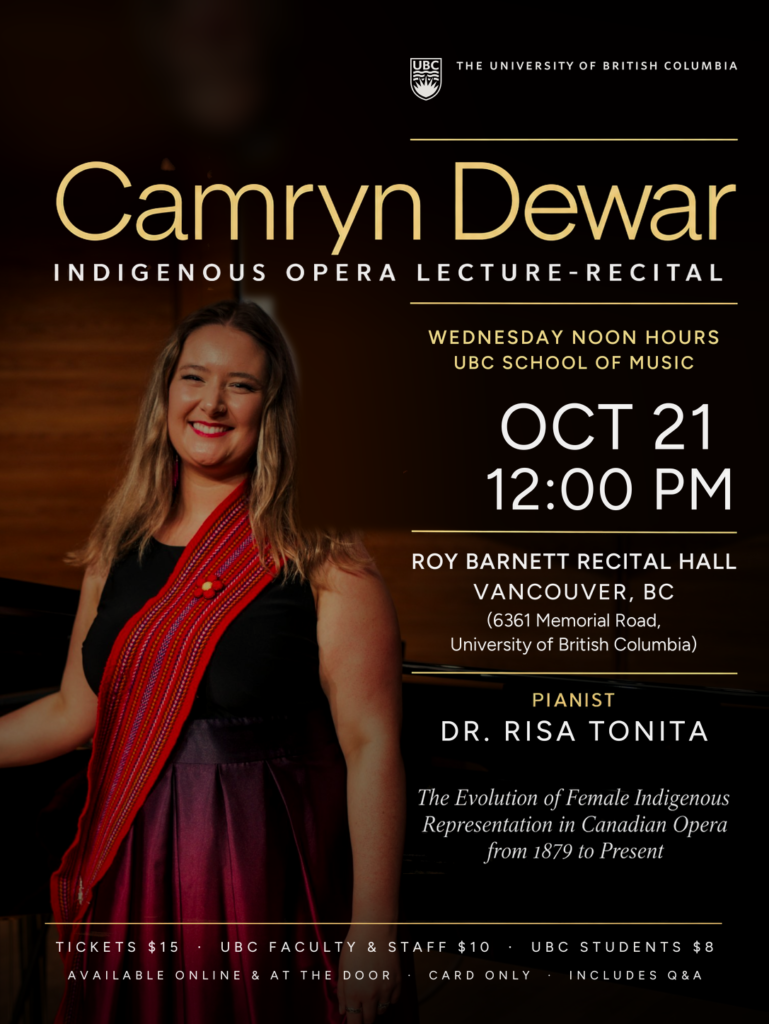
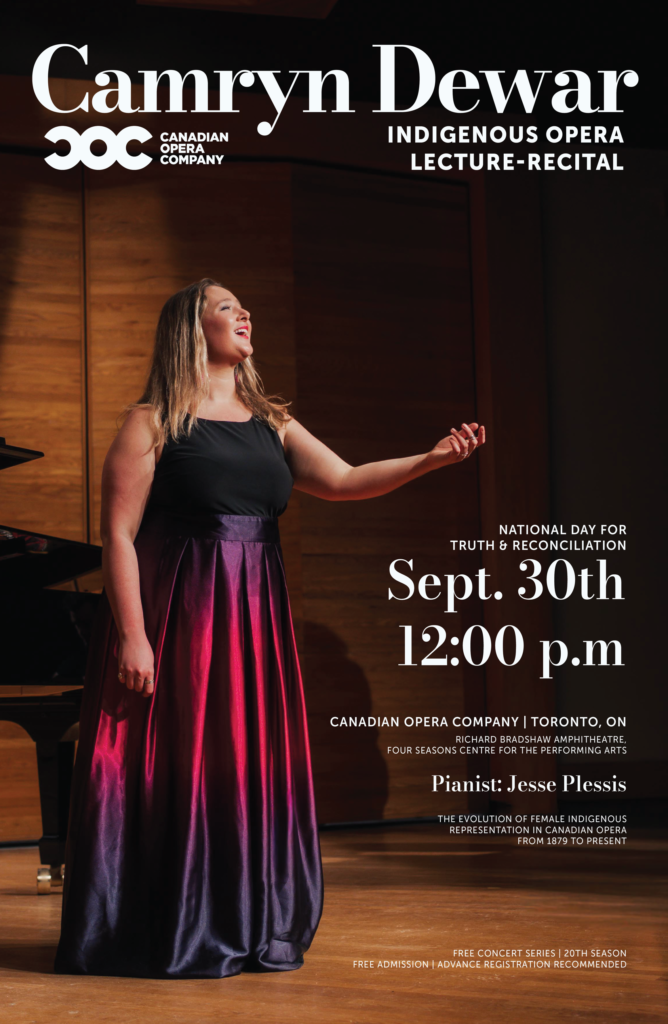
September 30, 2026 — Canadian Opera Company, Toronto, Ontario with pianist Jesse Plessis
Richard Bradshaw Amphitheatre, Four Seasons Centre for the Performing Arts
12:00–1:00 p.m. — National Day for Truth and Reconciliation. Culture DaysOctober 21, 2026 — University of British Columbia, Vancouver, British Columbia with pianist Dr. Risa Tonita.
Roy Barnett Recital Hall, UBC School of Music
12:00–1:00 p.m. — Wednesday Noon Hours series. School of MusicYukon Tour — April 2027
In partnership with Gwaandak Theatre.

“[I always] view non-Métis works about us with a little bit of skepticism. What’s always missing is the Indigenous voice.”
Adam Gaudry, Indigenous scholar and Métis historian
How have Indigenous women been portrayed on the Canadian opera stage, and what changes when Indigenous artists become part of telling their own stories?
Red River Métis soprano and Fulbright Scholar Camryn Dewar explores nearly 150 years of Indigenous women’s representation in Canadian opera through live performance, research, storytelling, and discussion.
Developed through Camryn’s Fulbright research, the lecture-recital traces the evolution of Indigenous female characters. It begins with some of the earliest representations in Canadian opera and moves to a new generation of works increasingly shaped by Indigenous composers, librettists, performers, and communities.
“As Indigenous artists become part of telling our own stories, in our own voices, we’re finally seeing more whole and honest depictions of who we really are.”
Camryn Dewar
From 1879 to a New Generation of Indigenous Opera
Through live operatic excerpts with piano, historical context, and visual presentation, Camryn examines landmark works in Canadian opera:
- Canada’s Welcome (1879): music by Arthur Clappé, libretto by Frederick A. Dixon
- Missing (2017): music by Brian Current, libretto by Marie Clements
- Shanawdithit (2019): music by Dean Burry, libretto by Yvette Nolan
- Li Keur: Riel’s Heart of the North (2023): music by Alex Kusturok and Neil Weisensel, libretto by Suzanne M. Steele
- Empire of Wild (Canadian Opera Company world premiere, 2027): music by Ian Cusson, libretto by Cherie Dimaline
Together, these works reveal profound changes in who creates Indigenous characters, whose perspectives shape their stories, and how Indigenous women are represented on the operatic stage.
Camryn also brings a performer’s insight to the program, having sung roles in both Missing and Li Keur.
More Than a Performance
The program runs about one hour and is part performance, part lecture, and part conversation. It draws on Camryn’s perspective as both performer and researcher.
The presentation explores:
- historical context, source material, and Indigenous languages, including Michif
- the backgrounds and perspectives of composers, librettists, and performers
- changing approaches to character and storytelling
- cultural collaboration and performance practice
- the movement away from romanticized and stereotypical portrayals
- the growing role of Indigenous artists in creating, performing, and shaping their own stories
A moderated or audience Q&A can follow the performance.
The program is designed to invite conversation rather than simply present a history. It asks audiences to consider how opera has portrayed Indigenous people, how those portrayals have changed, and what authentic collaboration can look like as new works move from development to the stage.
From Fulbright Research to the Stage
Camryn developed the lecture-recital as a Fulbright Scholar in the United States and first presented it on a state-wide New Jersey tour in 2025.
She has since brought the project to Canadian audiences at McGill University, the University of Calgary, Brandon University, and the University of Manitoba. The 2026–2027 tour expands to opera companies, universities, arts organizations, and communities across Canada.
As the repertoire of Indigenous-created opera continues to grow, so does the lecture-recital. Camryn keeps adding new works and perspectives, so the program stays connected to what is happening on Canadian stages today.
Truth, Reconciliation and the Arts
For Camryn, the project is about more than documenting changes in opera. It examines who has historically been given the opportunity to tell Indigenous stories, and what becomes possible when Indigenous artists take part in creating, interpreting, and performing those stories themselves.
The lecture-recital creates space for audiences to listen, learn, and consider the role the performing arts can play in truth, cultural understanding, and reconciliation. It is especially suited to National Day for Truth and Reconciliation programming, and it is offered throughout the 2026–2027 season.
For Presenters
Indigenous Voices in Canadian Opera is suited to universities and music schools, opera companies, conservatories, Indigenous studies programs, arts and cultural organizations, conferences, museums and cultural institutions, and community organizations.
The program can be adapted for different audiences and settings. Options include the complete lecture-recital, selected musical excerpts, an artist talk, a classroom or student discussion, and an audience Q&A.
At a glance
- Length: about 60 minutes, plus Q&A
- Performers: Camryn Dewar, soprano, with a collaborative pianist
- Technical needs: tuned acoustic piano, projector and screen, and a microphone for spoken portions
- Presenter kit: rate sheet, stage plot, bios, and headshots are available on request
Book the Lecture-Recital
Camryn welcomes inquiries from presenters interested in bringing the lecture-recital to their institution or community.
Booking: music@camryndewar.com
“The first time I sang an Indigenous opera, I felt my entire soul pouring out of my body. I could feel my ancestors behind me as I figuratively cried out for justice, truth, and understanding. It is a feeling I will never forget. That experience showed me that my true purpose is serving as an educator about Indigenous peoples and music, and using the power of music to foster understanding and reconciliation. I look forward to audiences hearing operas that are real, raw, and that fully show the Indigenous female, and really, the human, experience.”
– Camryn Dewar